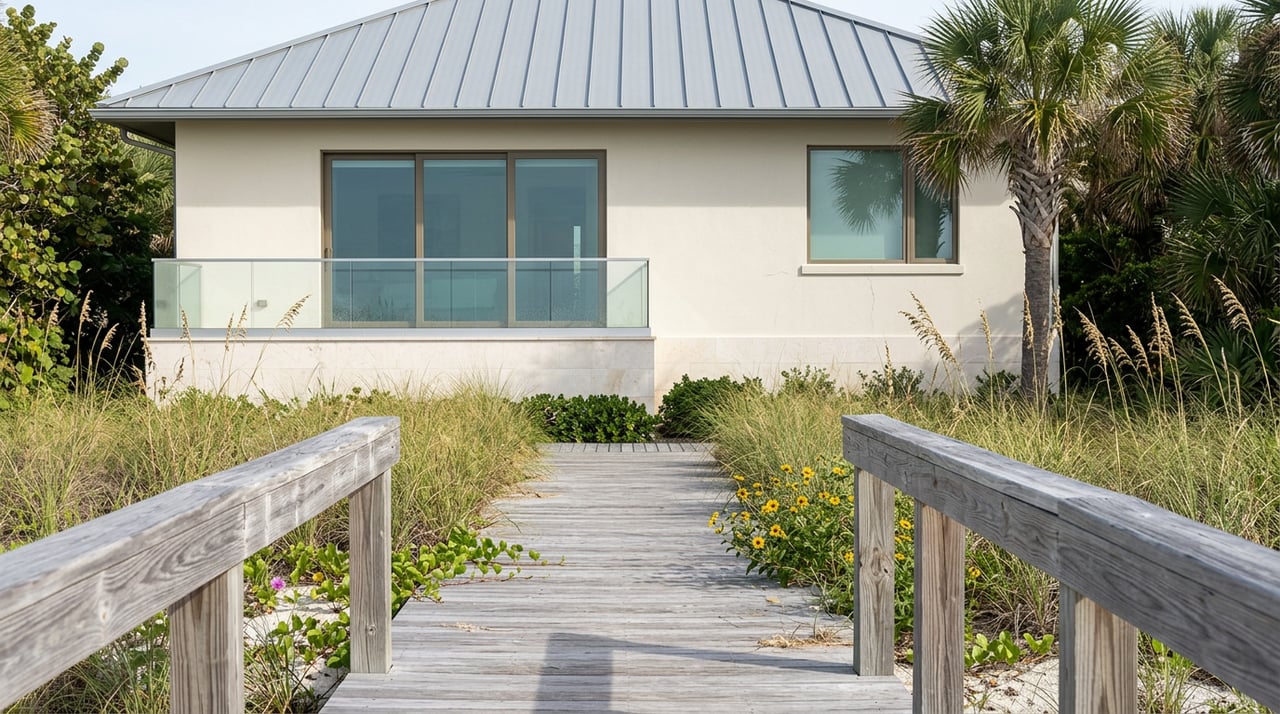
Walk out to the Lido Beach Pavilion this fall and you'll find the sand looking better than it has in years, freshly widened by a renourishment project that wrapped up in May. You'll also find at least one of the beach's three main walkovers roped off, posts marking a temporary detour, work crews building six-foot dunes where the sand used to just trail off flat into the parking lot. It's tempting to read that as ordinary contractor scheduling, the kind of thing that slips a few weeks depending on weather and permits. It isn't. The start date for that work was chosen months in advance, and it was chosen by a bird.
A short drive away on St. Armands Circle, a different kind of clock is running. A storefront that's been vacant since the 2024 hurricanes is finally being torn down to the studs, and the timeline for its return has slipped by close to a year since the project was first announced. That delay isn't contractor drift either. It's a federal threshold in the fine print of a rebuilding permit, one that decides whether a storm-damaged building gets a quick patch or a ground-up rebuild to current flood code.
Neither of these clocks is on the city's calendar in any way you'd notice unless you knew to look. Here's what's actually setting the pace of what you'll see on Lido Key this fall.
The Beach Runs on the Birds' Schedule
North Lido Beach, just past the public access at John Ringling Boulevard and Benjamin Franklin Drive, has hosted a colony of black skimmers most years since at least 2011. Skimmers are a state-threatened shorebird, and this year's colony brought roughly 500 birds to that stretch of Lido, with another 300 apiece settling on Siesta Key and Longboat Key, according to Abby O'Donnell, Sarasota stewardship coordinator for Audubon Florida. A typical Lido colony runs somewhere between 700 and 1,300 adults, so this year tracked close to normal.
The birds nest directly on open sand, which means their entire breeding cycle, from egg-laying through fledging, has to finish before anyone can safely bring in dune-building equipment. That's the actual reason the city's dune and walkover project is scheduled to begin this fall rather than earlier in the year. The city's own project page lists coordination with Mote Marine Laboratory and local Audubon conservation staff as part of the planning, and the original 2025 announcement specified that construction was timed to start after nesting season closes.
A few numbers on this year's colony, for context:
- Roughly 500 adult skimmers settled on North Lido Beach this spring, per Audubon Florida's count
- The typical Lido colony ranges from 700 to 1,300 adults in a given season
- Skimmers have nested on this stretch of beach in most years going back to at least 2011
By the time crews move in this fall, the chicks that hatched around Memorial Day will have fledged and the colony will have largely dispersed. The dune work isn't waiting for cooler weather. It's waiting for the birds to leave first.
What Actually Gets Rebuilt, and Where
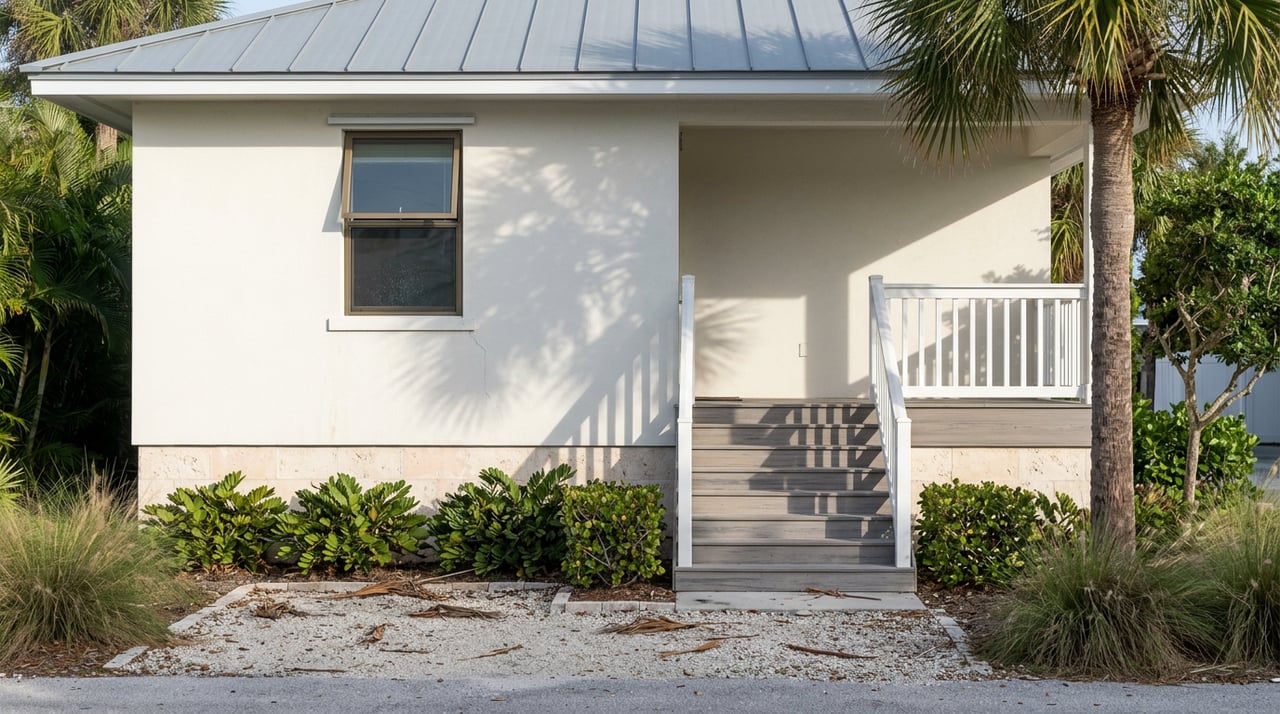
The dune project itself is a direct response to storm damage. Hurricanes Helene and Milton scattered so much beach and dune sand across roads and parking lots that much of Lido Beach was left with no dune protection at all going into the 2025 season. The fix underway now raises existing dunes by about two feet to a height of 6.6 feet, which the city says moves storm protection from a 10-year event standard to a 25-year one. Dune grasses and other salt-tolerant vegetation get planted alongside to help the sand hold.
Three separate beach walkovers are being torn out and replaced as part of the same effort. Here's where you'll actually run into construction if you're a regular at the beach:
| Walkover Location | What's Happening |
|---|---|
| Lido Beach Pavilion | Full replacement, tied to the pavilion's main dune-crossing point |
| North end of the pavilion parking lot | Full replacement |
| North Lido Beach access at John Ringling Blvd / Benjamin Franklin Dr | Full replacement, at the same access point where this year's skimmer colony gathered |
That last one is worth sitting with. The walkover getting rebuilt is the exact access point the skimmer colony used this spring. The birds nested there because the sand was wide and undisturbed, and now that they've moved on, that's precisely where the city is bringing in equipment. The total cost for the three walkovers runs about $840,000, with the dune construction itself budgeted near $1.2 million. Both projects are expected to wrap by spring 2027, and the beach stays open throughout, with periodic restrictions only around active work zones.
If you're wondering why the sand looks so good right now, that's the renourishment project finishing just ahead of this: roughly 300,000 cubic yards of sand, dredged from New Pass and spread across 1.2 miles of shoreline, funded by $12 million in federal money and completed with a ribbon-cutting at the Pavilion on May 26. That project and the dune work are related but distinct phases of the same multi-year city and Army Corps of Engineers agreement, one that also produced the 2021 renourishment most longtime residents remember.
On the Circle, the Clock Is a Federal Rule, Not a Bird
The corner of Madison Drive and North Boulevard of the Presidents has sat mostly fenced off since late 2024, when Shore Restaurant closed after taking on several feet of saltwater during back-to-back hurricanes. Owner Tom Leonard leased his old space at 465 John Ringling Boulevard to Tommy Bahama, which was itself relocating after its previous spot less than a mile away also flooded. Two well-known Circle tenants effectively swapped storm damage for a working building, which tells you something about how uneven the flooding was, block to block.
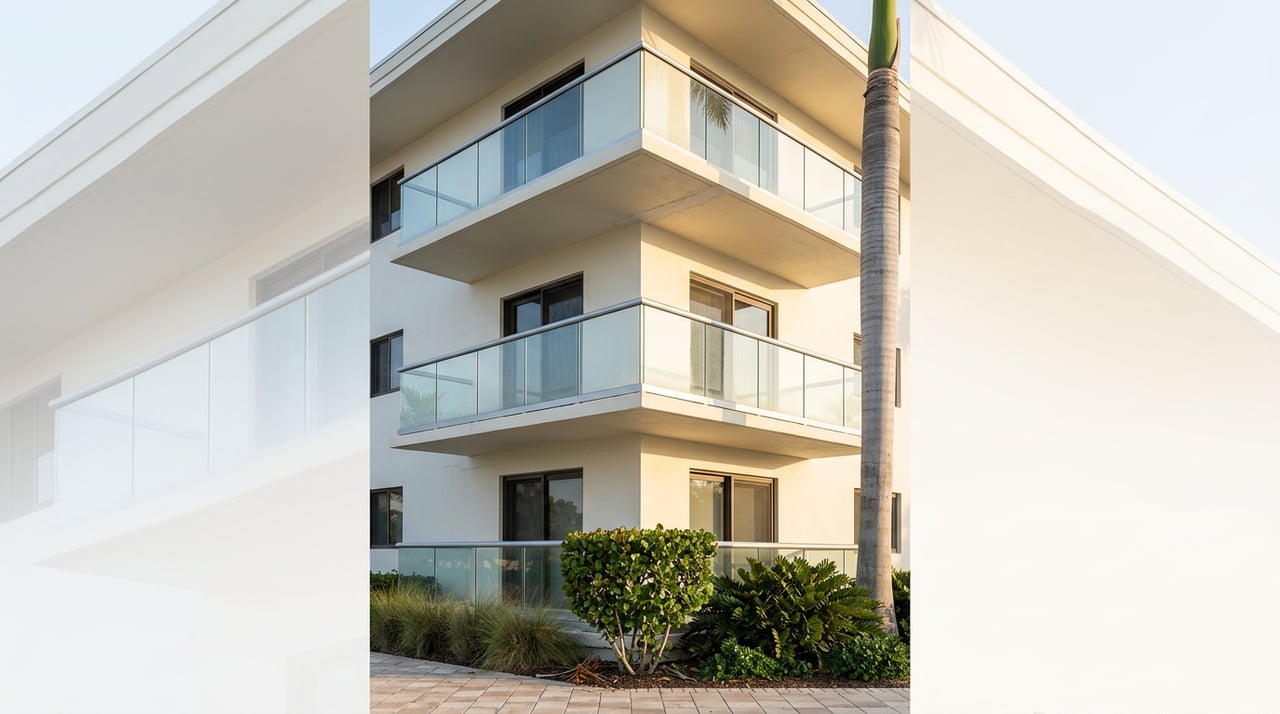
Leonard's plan to bring Shore back to St. Armands runs through a different piece of federal fine print than the one governing the beach: FEMA's 50% rule. If the cost of repairing a flood-damaged building exceeds half the structure's pre-storm value, the whole project has to meet current flood code rather than get a simple repair. During a December 2025 pre-application meeting, city reviewers looked up the appraised values of the two buildings at 24 and 28 N. Boulevard of the Presidents, a combined roughly $1.2 million, and told Leonard's team the project would almost certainly cross that 50% line. That single determination is why the new Shore isn't a repaint and reopen. It's a full three-story rebuild with flood-resistant glass on the ground floor.
"It's time for a little love on the Circle," Leonard said of the project.
That love comes at a cost. The flood-proof glass alone runs about $500 per linear foot, and the building is being reworked into roughly 17,000 square feet with a cafe and retail on the ground floor, a restaurant on the second, and a proposed eight-room boutique hotel on the third pending Planning Board approval. Demolition on the two buildings finished earlier this year, with crews taking both structures down to the concrete and steel. A formal site plan went before the city's Development Review Committee on July 15.
The timeline has moved as the scope has grown. Leonard's December 2025 announcement floated a spring 2027 opening. By April, that had shifted to a fall 2027 opening for the cafe and retail space, with the restaurant following a few months later. The most recent reporting from July puts full completion, including the third floor, at early 2028 if approvals go smoothly, and Leonard himself has said he isn't certain the top floor finishes on that schedule at all. None of that is a contractor missing deadlines. It's what happens when a rebuild has to clear a federal threshold rather than just a construction schedule.
Not every storefront on the Circle is waiting on that clock. A few blocks over, Nōnnō Umberto, the rebrand of the longtime Le Colonne at 22 S. Boulevard of the Presidents, finished its own renovation in time for a New Year's opening and served more than 250 people on its first night alone, growing to roughly 800 covers over its first week. Owners Simone Salustri and Amber Mayner kept the space in the family, naming the new restaurant for Simone's father, Umberto, who opened the original. Theirs was a facelift, not a federal case, and it shows in how fast it came back online.
What You'll Actually Notice This Fall
If you're out walking the beach this season, expect one of the three main walkovers to be under construction at any given time, with the work moving from pavilion to parking lot to the John Ringling access point as crews clear each nesting-season restriction. Expect the sand itself to look better than it has in a while, since the renourishment work is already behind you. If you're driving the Circle, expect the fencing at Madison and North Boulevard of the Presidents to stay up well into next year, while Nōnnō Umberto's dining room stays full most nights as proof that not every rebuild on this island runs on the same schedule.
Two different clocks, one shaped by shorebird biology and one shaped by a federal repair-cost formula, are quietly setting the pace of what changes around you this fall. Neither one answers to a contractor, and knowing which is which tells you a lot more about what you'll actually see out your window than any construction sign does.
If you're a longtime Lido Key or St. Armands neighbor and questions like this ever turn into a conversation about your own property, that's exactly the kind of local detail The Ackerman Group tracks block by block. When you're ready to talk through what any of this means for your home, we're a phone call away.